
Moon Chart This Week
Planning a week of Moon watching, photography or dark-sky stargazing? This chart shows the Moon for each of the next seven nights — its shape, how much is lit, when it rises and sets where you are — and suggests which features to look for through binoculars or a small telescope.
- Free to use
- No sign-up
- Runs in your browser
This week’s Moon
Rise and set times are shown in your device’s time zone.
Moon Observing Pack
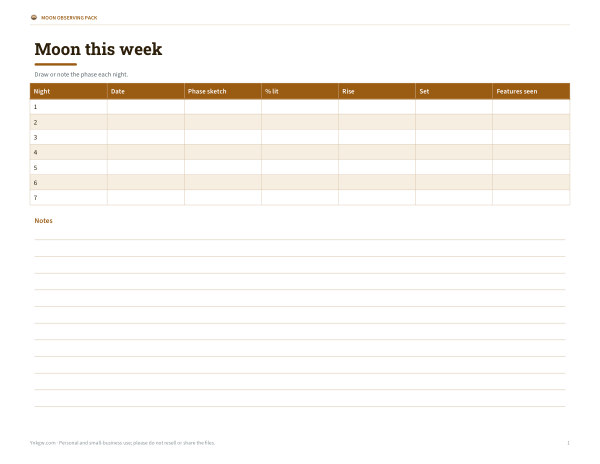
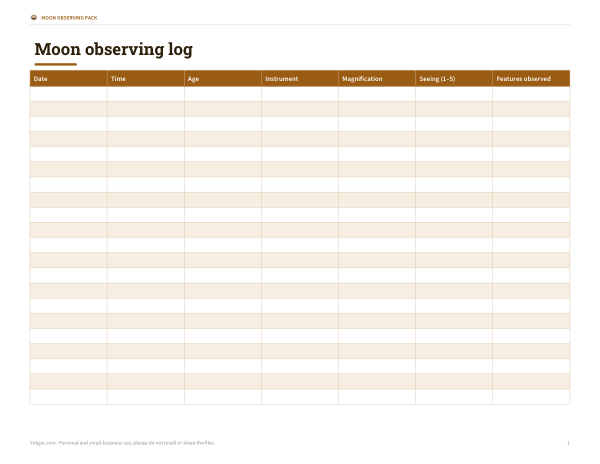
Printable weekly and monthly Moon phase charts, a lunar feature observing checklist by Moon age, a Moon observing log and blank Moon disc sketch sheets.
- Weekly chart (PDF)
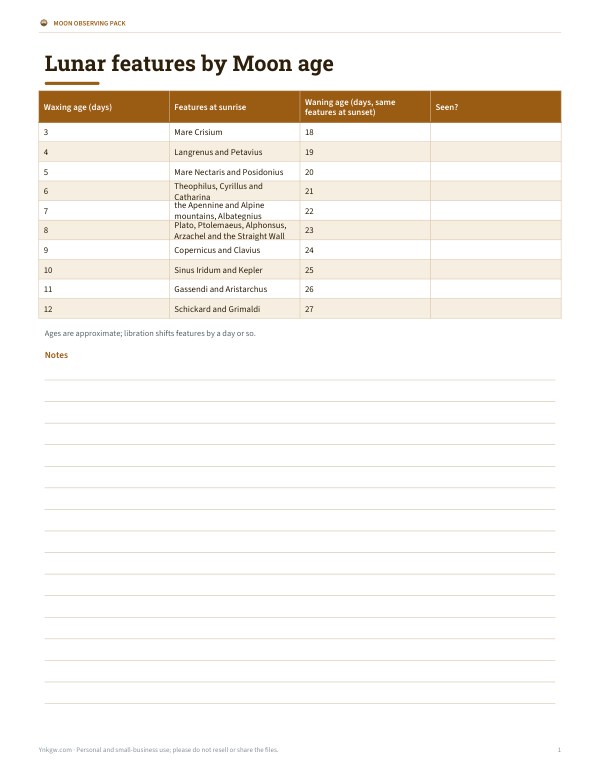
- Feature checklist (PDF/DOCX)
- Observing log (PDF/DOCX/XLSX)
- Sketch sheets (PDF)
Formats: PDF, DOCX, XLSX. Instant download after payment (link valid 72 hours, up to 5 downloads). AI-assisted: the templates were drafted with AI help and reviewed and laid out before publishing.
$5.00 USD, one-time 4 files · about $1.25 each
- Instant download
- 7-day refund
- Secure checkout by Stripe
7-day money-back guarantee. Full refund within 7 days of purchase, even after you download.
Free sample: Moon Observing Log (PDF, 55 KB)
Full refund within 7 days — see the refund policy and license.
Free printables
Single sheets you can print right now, no sign-up. The full pack adds every sheet in one download plus the editable files.
 Printable Moon Sketch Sheet
Reading the weekly Moon chart
Each card shows one evening. The drawing shows the Moon’s lit shape as seen from your hemisphere, the percentage tells you how much of the disc is lit, and the age counts days since the last new Moon. Moonrise and moonset tell you when the Moon is above the horizon: a waxing Moon is up in the evening, a waning Moon rises late and lights the early morning sky.
The Moon’s cycle in a week
| Phase | Age (days) | Rises around | Best seen |
|---|---|---|---|
| New Moon | 0 | Sunrise | Not visible — darkest skies |
| Waxing crescent | 1–6 | Mid-morning | West after sunset |
| First quarter | 7–8 | Noon | South at sunset (north of the tropics) |
| Waxing gibbous | 9–13 | Afternoon | Evening and most of the night |
| Full Moon | 14–15 | Sunset | All night |
| Waning gibbous | 16–21 | Evening | Late night to morning |
| Last quarter | 22 | Midnight | South at sunrise |
| Waning crescent | 23–29 | Early morning | East before sunrise |
In one week the Moon moves through roughly a quarter of its 29.5-day cycle, so a week that starts at new Moon ends near first quarter.
What to look for along the terminator
| Moon age (waxing) | Features catching sunrise |
|---|---|
| 3 | Mare Crisium |
| 4 | Langrenus and Petavius |
| 5 | Mare Nectaris and Posidonius |
| 6 | Theophilus, Cyrillus and Catharina |
| 7 | the Apennine and Alpine mountains, Albategnius |
| 8 | Plato, Ptolemaeus, Alphonsus, Arzachel and the Straight Wall |
| 9 | Copernicus and Clavius |
| 10 | Sinus Iridum and Kepler |
| 11 | Gassendi and Aristarchus |
| 12 | Schickard and Grimaldi |
The terminator — the line between lunar day and night — is where shadows are longest and craters and mountains stand out in sharp relief. After full Moon the same features appear again, this time at sunset, about 14.8 days later: Mare Crisium around day 18, Copernicus around day 24. The full Moon itself is flat-looking but shows bright ray systems around Tycho and Copernicus.
Worked example
Someone in Chicago plans a week of observing with a small telescope. The chart shows a waxing crescent on Monday at 19% lit, setting before midnight — good for the craters near the terminator such as Theophilus. By Thursday the Moon is at first quarter, high in the south at dusk, with the Apennine mountains and the Straight Wall on the terminator. Anyone hoping to photograph faint galaxies that week would choose Monday after moonset, before the brighter Moon dominates the evening sky.
Moonrise, moonset and the ecliptic
On average the Moon rises about 50 minutes later each day, but the gap varies from under 30 minutes to more than an hour depending on the season and your latitude. Around the September equinox in the northern hemisphere, the full Moon’s path makes a shallow angle with the evening horizon, so it rises only a little later on successive nights — the effect behind the “Harvest Moon” name. Near the spring equinox the opposite happens and moonrise times jump by an hour or more each night.
Planning photography and dark-sky nights
| Goal | Best Moon | Why |
|---|---|---|
| Milky Way and faint galaxies | New Moon ± 3 days | Dark skies all night |
| Crater detail | Crescent to gibbous | Long shadows along the terminator |
| Moon over a landscape | Full Moon at moonrise | Moon and landscape similar in brightness at dusk |
| Earthshine | Crescent, 2–5 days old | Bright Earth lights the dark side |
| Meteor showers | New or thin crescent | Moonlight drowns faint meteors |
Use the rise and set times on each card to find the dark window between moonset and dawn, or between dusk and moonrise.
Moon watching tips
- Binoculars show the maria, larger craters and earthshine on a young crescent.
- A small telescope at low power shows mountain ranges and crater walls along the terminator.
- A Moon filter or sunglasses-style ND filter makes a bright gibbous Moon comfortable.
- Photograph the Moon at a fast shutter speed — it’s sunlit and much brighter than it seems.
- For dark-sky stargazing, plan around the new Moon.
Why the Moon looks different in the southern hemisphere
Observers south of the equator see the Moon “upside down” compared with the north: a waxing crescent is lit on the left rather than the right. The chart flips the drawings when you enter a southern latitude. Near the equator, the crescent can appear to lie on its back like a bowl.
Privacy
All calculations run in your browser; your location is not sent anywhere.
Frequently asked questions
What is the Moon phase this week?
The chart shows each of the next seven nights; change the start date to see any week.
How long is a lunar cycle?
About 29.5 days from new Moon to new Moon.
When is the best time to see craters?
Near the terminator, especially between crescent and gibbous phases.
Why does moonrise get later each day?
The Moon moves east around its orbit, so it rises on average about 50 minutes later each day.
What is earthshine?
Sunlight reflected from Earth faintly lighting the dark part of a crescent Moon.
When is the next full Moon?
The chart lists the next new, first quarter, full and last quarter Moons with dates and times.
What does Moon age mean?
The number of days since the last new Moon; about 7.4 at first quarter and 14.8 at full.
Can I print the week?
Yes — the Print button makes a one-page weekly Moon chart.
Why is the Moon sometimes up during the day?
Around the quarters the Moon is about 90° from the Sun, so it is above the horizon for much of the daylight.
Are the times exact?
They are computed with a compact lunar model and are typically within a few minutes.